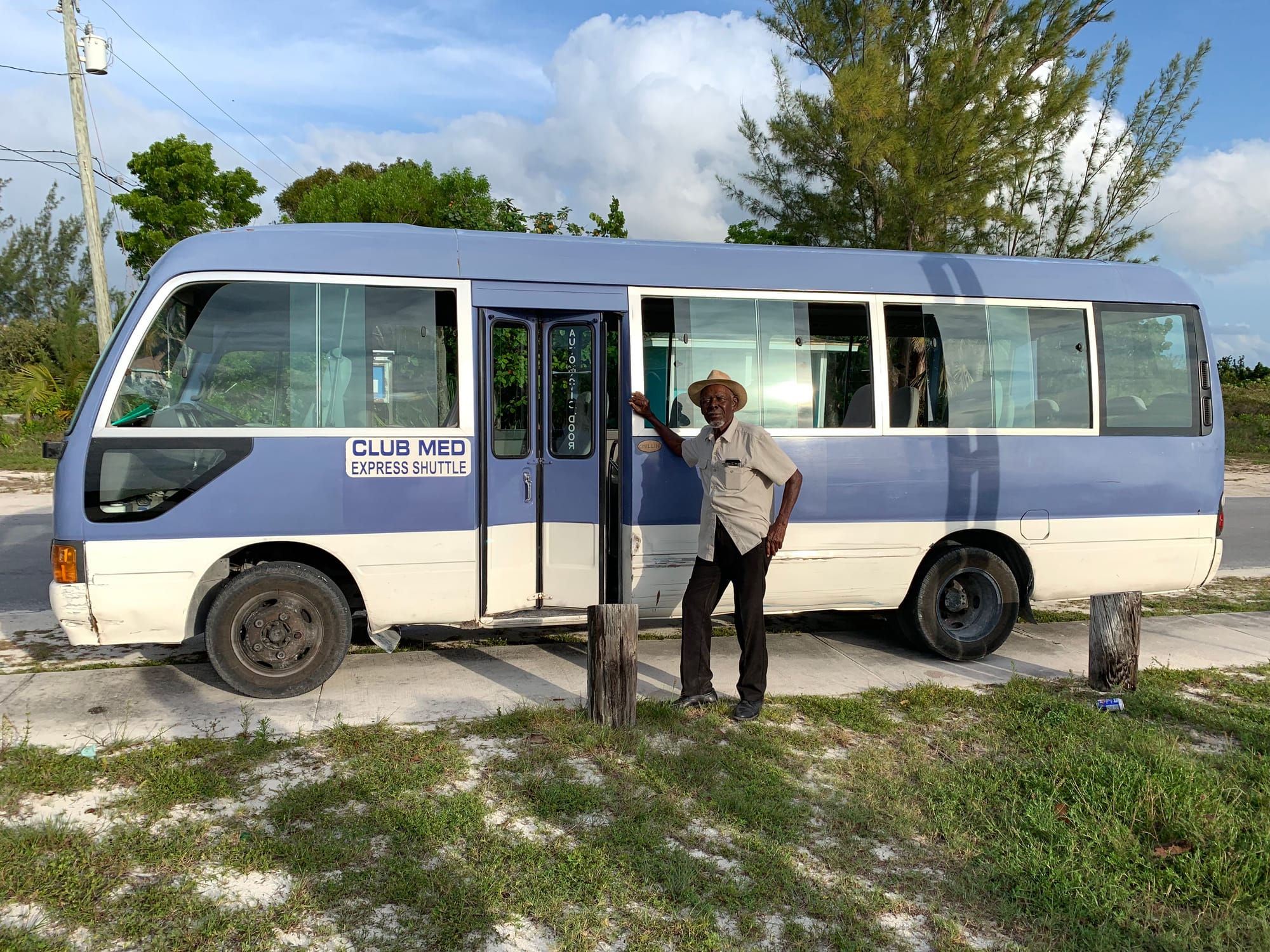
Centuries before any European saw this stretch of ocean, Arawakan-speaking peoples had been moving north out of South America and into the Caribbean, eventually becoming what we now call the Taíno — the people who would later be encountered across Cuba, Hispaniola, Puerto Rico, and Jamaica. The Lucayans were the northernmost branch of that migration: the Taíno of the Bahamas specifically, having settled the islands by around 700 AD. They called themselves Lukku-cairi — island people. By 1492 they numbered roughly 40,000 across the archipelago.
They lived well, despite a real obstacle most visitors never think about. The Bahamas have no rivers, no lakes, and no streams. The islands are limestone through and through, and rainwater simply disappears into the porous rock. The Lucayans became experts at collecting rainwater and locating natural seeps and shallow caves where fresh water collected close to the surface, a skill that later Bahamians, including the British settlers who followed centuries afterward, had to relearn for themselves. Eighty percent of what the Lucayans ate came from the sea. They built round, thatched houses called bohíos, housing extended families on hammocks they had invented themselves — a technology so effective the Spanish adopted it immediately for their own ships and carried it back to Europe, where it spread to sailors worldwide. Their society traced descent through the mother's line. They kept dogs they loved enough to wear the animals' teeth as pendants, believing a divine spirit guarded the dead in the shape of a dog. They had no written language, but they had trade routes, agriculture, craft, and a religion built around spirits called zemís believed to inhabit trees and the remains of the dead.
The word "Bahamas" itself comes from them. Not, as is often taught, from the Spanish baja mar, "shallow sea" — that is a popular myth. The name was actually Lucayan to begin with, originally describing Grand Bahama Island, and meaning roughly "large upper midland."
European Influence and Genocide
On October 12, 1492, Christopher Columbus anchored off an island the Lucayans called Guanahaní. He renamed it San Salvador, Holy Savior, in gratitude for safe passage across an ocean he had spent five weeks trying to cross. He wrote in his journal that the people who greeted him had "unpleasantly broad foreheads" — in fact the result of deliberate, intentional head-shaping, a practice of beauty, not affliction — and compared their skin to that of "sunburnt peasants." Because the Bahamas had no gold, Spain dismissed the entire archipelago as islas inútiles: useless islands.
That dismissal is precisely what made the following genocide so efficient, and so quickly forgotten. Beginning in 1509, organized Spanish slave raids began removing Lucayans to work the mines and pearl fisheries of Hispaniola and Cuba. By 1520, when the Spanish came looking to ship out whoever remained, they could find only eleven Lucayans left in the entire Bahamas. Out of 40,000 people, eleven. The islands then sat uninhabited for the next 130 years.
This is usually called the discovery of the New World. It was also the extinction of an old one, and it happened almost entirely within a single generation.
The exact island Columbus landed on is still disputed among historians — some argue for Cat Island or Samana Cay instead — but San Salvador remains the most widely accepted site, and a stone cross at Long Bay marks the traditional spot today.
That history is mostly invisible now. There is no Bahamian festival dedicated to the Lucayans. No annual celebration of their culture. Junkanoo, the country's great cultural festival, traces its roots instead to enslaved Africans in the 17th century, with only faint, debated traces of Lucayan influence folded in along the way. African heritage arrived in the Bahamas roughly two and a half centuries after the Lucayans were gone — not by choice, but through the transatlantic slave trade and, most significantly, through British Loyalists fleeing the American Revolution in the 1780s, who brought thousands of enslaved people with them to work the same land the Lucayans once lived on. Today, the vast majority of Bahamians descend from those slaves. What remains of the Lucayans are mostly place names.
Today
San Salvador today is a small, quiet island of fewer than a thousand people, twelve miles long and five miles wide, sitting on the eastern edge of the Bahamian archipelago, in the Atlantic rather than the Caribbean proper. You'll often see it described, including by local dive operators, as the exposed tip of a volcanic mountain rising 15,000 feet from the ocean floor. It's a great story and it's repeated everywhere in dive tourism material. It's also wrong. Geologically, San Salvador's bedrock is entirely limestone, built up over millions of years from compacted coral, shells, and marine sediment, not volcanic rock at all. What's true, and arguably more interesting, is that San Salvador sits on its own isolated carbonate platform, separate from the rest of the Bahamas, with edges that plunge to depths beyond 4,000 meters at angles as steep as 85 degrees. That isolation and depth, combined with the island's exposure to the Antilles Current before it merges into the Gulf Stream, is what pulls in pelagic species rarely seen on the shallower banks nearby — most famously, scalloped hammerhead sharks.
The Diving
I've been lucky enough in my yachting career that my job brings me to stunning diving locations like San Salvador. Twice on a little 116ft Crescent Custom and twice now on the 70m yacht where I'm currently the Purser and Adventure Coordinator. On both boats, we've anchored in the same location — right off Cockburn Town (pronounced co'burn) and, with reliable easterly winds, your anchor is in the sand and your stern is right near the edge of the wall. For divers, this is exceptionally exciting, as it allows you to dive the wall right from your boat instead of diving from a smaller tender.
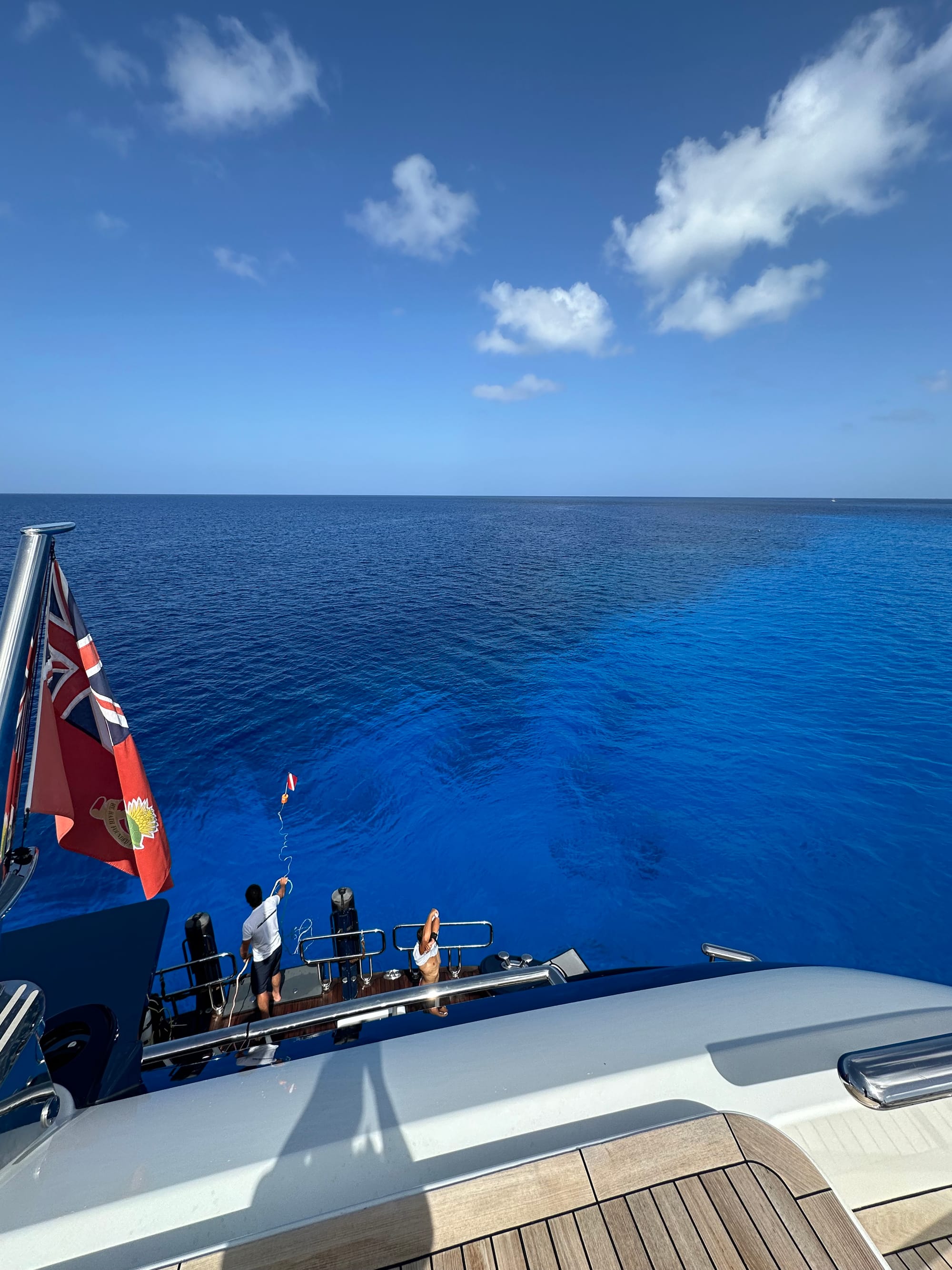
The local dive operators chum the water to bring sharks in for their guests, and on one of our more recent dives we had brought chumsicles down with us. When the guests go on a fishing trip and come back with a tuna, for example, we'll save the carcass after it's filleted, stick it in a big bucket with some water, and freeze it into a fish/chum popsicle for the sharks. On this particular dive, we had one chumsicle and one frozen tuna carcass. When the ice and blood start melting in the 86°F water, usually sharks appear quite quickly. We dropped down the wall, went south, turned back, and were back at the mooring line when we heard a boat engine going by. A few moments later, one of our dive buddies screamed SHARK (yes, you can hear underwater) and we were inundated! The sharks must have all been occupied by the other boat's chumming and, after it left, decided to pay us a visit. It made for a very fun and eventful shark dive.
There's also a grouper the local dive guides have befriended, well enough that he has worked out exactly what divers are there to see. The locals have nicknamed him SpongeBob, although we've also heard the name Dicky Boy — although they might be differing names for the same grouper? He will swim with you for most of your dive, find an eel or a crab tucked into the reef, and wiggle in front of it until you notice. He is, genuinely, showing you around his neighborhood. He's likely learned this from the locals spearing invasive lionfish and feeding him; to get more lionfish, he's paid attention to what the divers like. (I refer to this fish as a he, as groupers are all born female and most transition to male with increased age, increased size, or if there is a lack of males due to overfishing.)
The reef itself is excellent. Sharks, channel clinging crabs, turtles, dramatic coral heads, swim-throughs with real structure. At the southern tip of the island we found a small, healthy cluster of staghorn coral. This matters more than it sounds like it does. A research team has been tracking coral decline at San Salvador specifically for over a decade, and staghorn, once common enough to form dense thickets when their study began, has in recent years become practically absent from the island's reefs. Staghorn is also listed as critically endangered globally, with populations down roughly 80 percent over the past 30 years, and a 2023 marine heatwave pushed it to functional extinction in parts of Florida. Finding a patch of it alive, branching, and visibly thriving at San Salvador, against that documented local decline, was a genuinely good moment in a sport where you brace yourself, more and more, to find the opposite.
Justin and his son Tom have also watched a hammerhead cruise through the shallows right beside the boat. My own sighting of hammerheads was deeper and briefer: at 154 feet on the west wall, a few hammerheads passed below me, never quite close enough, but unmistakable.
Worth Knowing
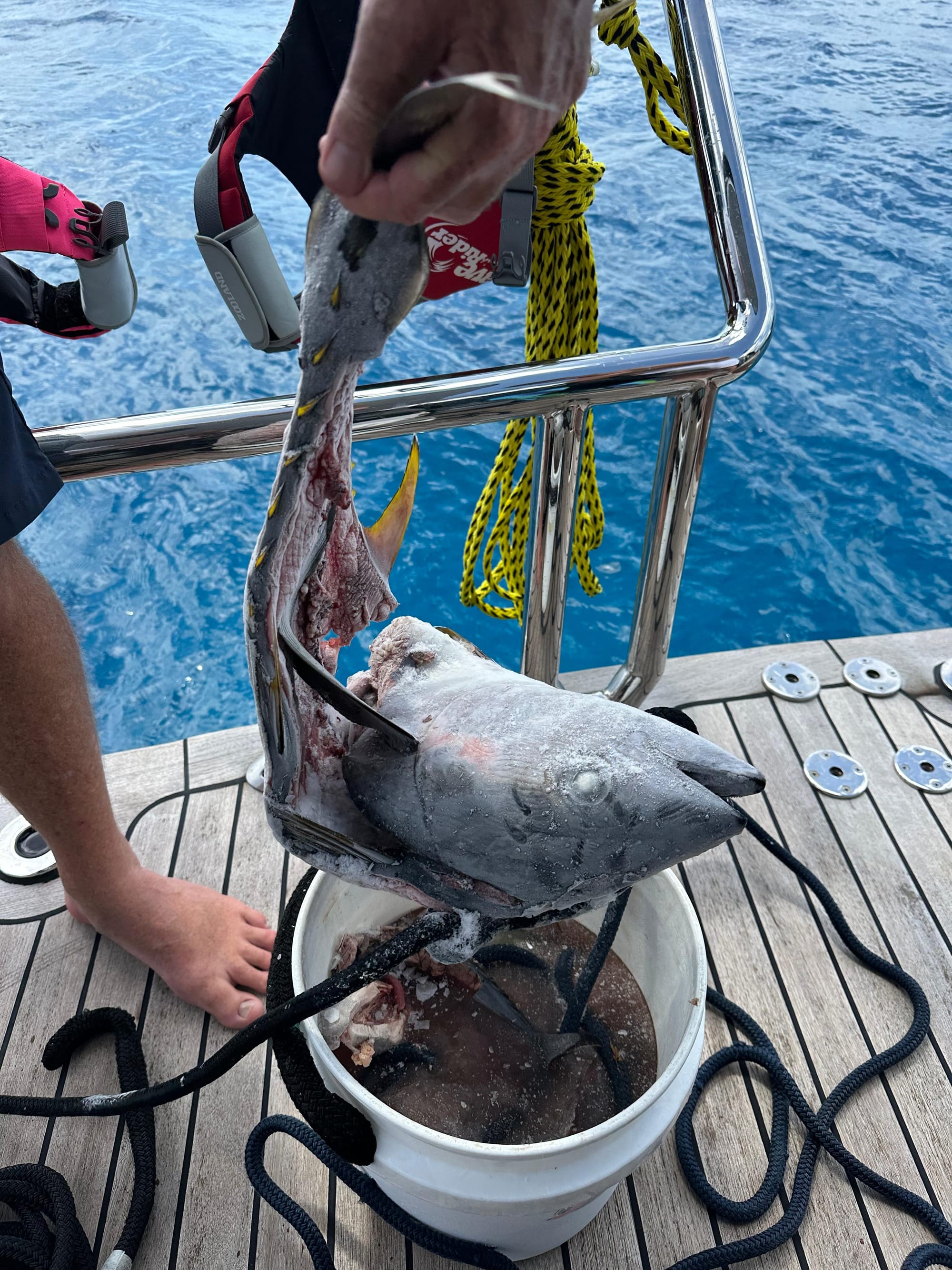
I have been to San Salvador four times now since 2018, and it wasn't until this last visit that I drove through the residential neighborhood of Cockburn Town. A few minutes from a Club Med resort with air conditioning, imported food, and resort-grade infrastructure, people are living simply, in homes that have clearly gone without proper materials or repair for a long time. Calling it poverty doesn't feel entirely accurate. We have never met anyone on island who seemed unhappy, and there is a contentment to island life that doesn't always show up in a word like that. But the disparity is real, and it sits uncomfortably close.
San Salvador has fewer than a thousand residents. Cockburn Town itself numbers only a few hundred. The island has no mayor — it is governed by a Family Island Administrator and a small elected council, with real decision-making power sitting far away in Nassau. A taxi driver told us that elected officials come around before elections, promising supplies and improvements that rarely arrive once the votes are counted. It is a familiar story in small, distant communities almost everywhere, but it is sharper here, on an island this small, this remote, and this overlooked.
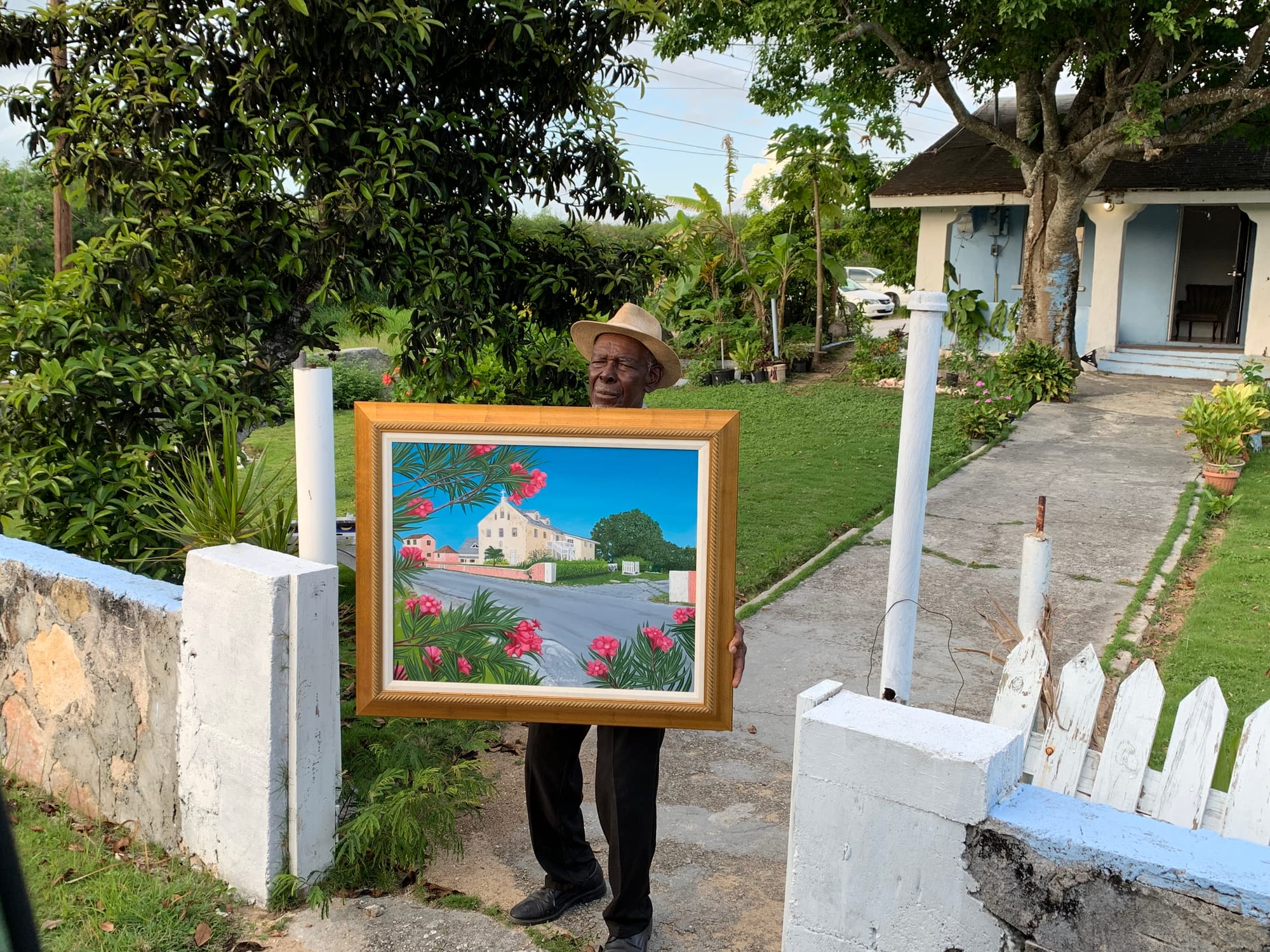
It is the place where contact with the outside world began, and where an entire civilization ended within a single generation. It deserves better than to be forgotten twice.
We don't have a clean answer for how to fix that. But if you visit San Salvador and find yourself moved by what you see, it is worth asking the locals directly what the island's residents actually need, and whether there's a way to give back beyond your dive fees and resort tab.
— Emerald
Sources
The Lucayans. Settlement of the Bahamas by the northern Taíno (Lucayans) by c. 700 AD; population ~40,000 by 1492; the self-name Lukku-cairi; matrilineal descent, bohíos, the Taíno invention of the hammock, zemí spirit beliefs, and dog symbolism — per the standard archaeology of the Lucayan Bahamas (William F. Keegan, The People Who Discovered Columbus; Smithsonian / National Museum of the American Indian). The "Bahamas" etymology (a Lucayan origin rather than Spanish baja mar) follows Lucayan-language scholarship, though the derivation remains debated among linguists.
Columbus and the landing. The 12 October 1492 landfall at Guanahaní / San Salvador, Columbus's journal descriptions (head-shaping, "sunburnt" skin), and the dismissal of the gold-less islands as islas inútiles — from Columbus's Diario (as transmitted by Bartolomé de las Casas) and standard Columbus scholarship. The landing-site dispute (San Salvador as the traditional site; Samana Cay per the 1986 National Geographic study; Cat Island as an older candidate) is long-running and unresolved.
The depopulation and after. Spanish slave raids from 1509, the removal of Lucayans to Hispaniola and Cuba, the count of roughly eleven by 1520, and ~130 years of depopulation — per Keegan and the colonial historical record. African heritage in the Bahamas via the transatlantic slave trade and 1780s Loyalist migration, and Junkanoo's African (not Lucayan) roots — standard Bahamian history.
Geology and oceanography. San Salvador as an isolated limestone carbonate platform (not a volcanic peak), with walls dropping beyond 4,000 m, and exposure to the Antilles Current / Gulf Stream drawing in pelagics including scalloped hammerheads — per carbonate-platform research associated with the Gerace Research Centre (University of the Bahamas), San Salvador. Scalloped hammerhead (Sphyrna lewini): IUCN Red List, Critically Endangered.
Staghorn coral. Acropora cervicornis: IUCN Red List Critically Endangered, ~80% decline over ~30 years; listed as Threatened under the US Endangered Species Act (NOAA Fisheries); the 2023 Florida marine heatwave drove local functional extinction in parts of the Florida reef tract (NOAA / widely reported). The decade-plus record of local staghorn decline at San Salvador comes from long-term reef monitoring on the island [Emerald to confirm the specific study/team citation].
The grouper. Groupers as protogynous hermaphrodites — born female, with many transitioning to male with age, size, or a shortage of males — per standard reef-fish biology (NOAA Fisheries; ichthyological literature).
Governance. San Salvador's administration by a Family Island Administrator and a local district council, with central authority in Nassau — per the Bahamas Department of Local Government structure.
Further Reading
William F. Keegan, The People Who Discovered Columbus: The Prehistory of the Bahamas — the fullest account of the Lucayan world before 1492.
National Geographic (1986) on the Samana Cay hypothesis — the case that Columbus's first landfall was not San Salvador, and the rebuttals that keep San Salvador the accepted site.
NOAA Fisheries and the IUCN Red List on Acropora cervicornis — the staghorn's status, the drivers of its collapse, and current restoration efforts.
The Gerace Research Centre, San Salvador — the island as a working field station for carbonate geology and reef science.
On Taíno survival and revival — the contemporary scholarship and Indigenous voices arguing that Taíno descent and identity persist in the Caribbean, a counterpoint to the clean "extinction" narrative.