Malé - more than an airport
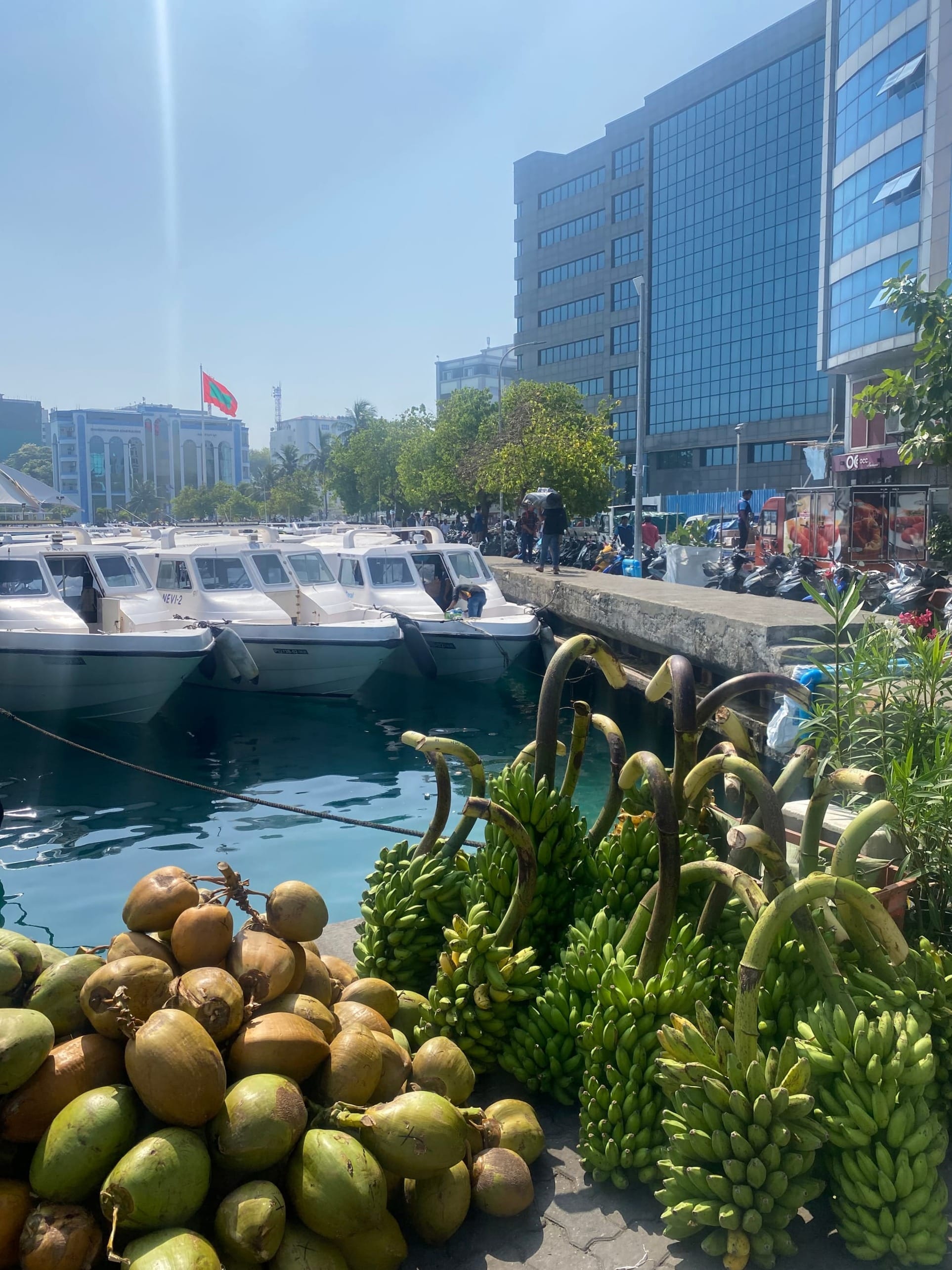
We arrived to the Maldives by boat, pulling up to Malé in the morning haze in late January, 2023. The atolls are barely visible above sea level and the tall buildings seem to be floating on open ocean. (The highest point on Malé is only 7.9ft/2.4m!)
Most tourists pass through Malé without stopping. They land at Velana International Airport, transfer to a speedboat or sea plane, and disappear toward a resort on an atoll where the water is impossibly blue and nobody thinks about the beating heart of the Maldives — Malé. That is their loss.
Malé is home to roughly 190,000 people packed into less than two square kilometres — a population density more than three times that of Manhattan. Every square meter is used. Buildings rise straight from the water’s edge. Streets are narrow, busy, and alive at all hours. There is no wasted space because there is no space to waste. It is one of the most densely populated places on earth, and walking through it feels exactly like that — vivid, loud, and completely real. It is not a resort. It is where the locals live. And it is worth an entire day of your time.
Start at the fish market — early
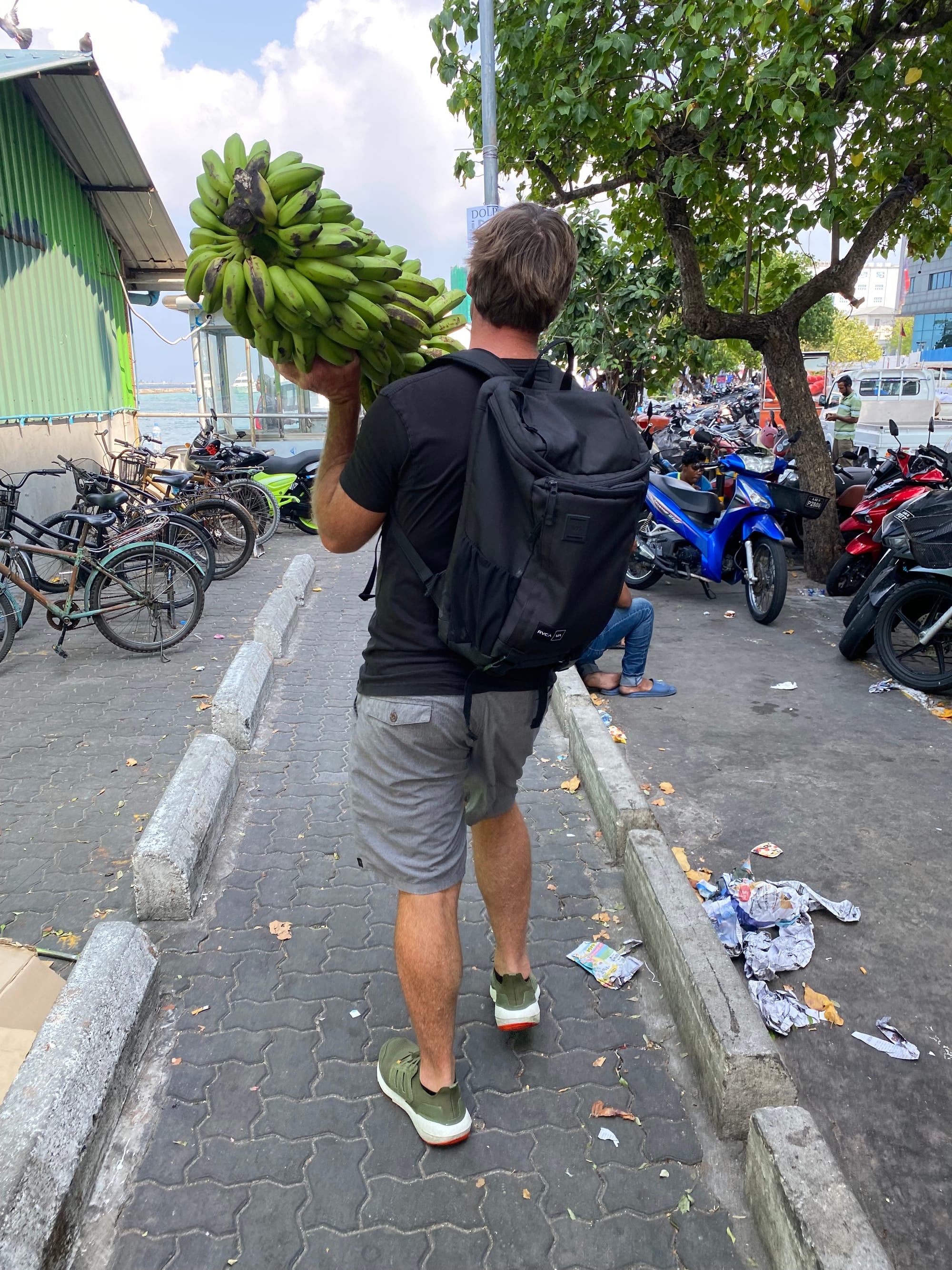
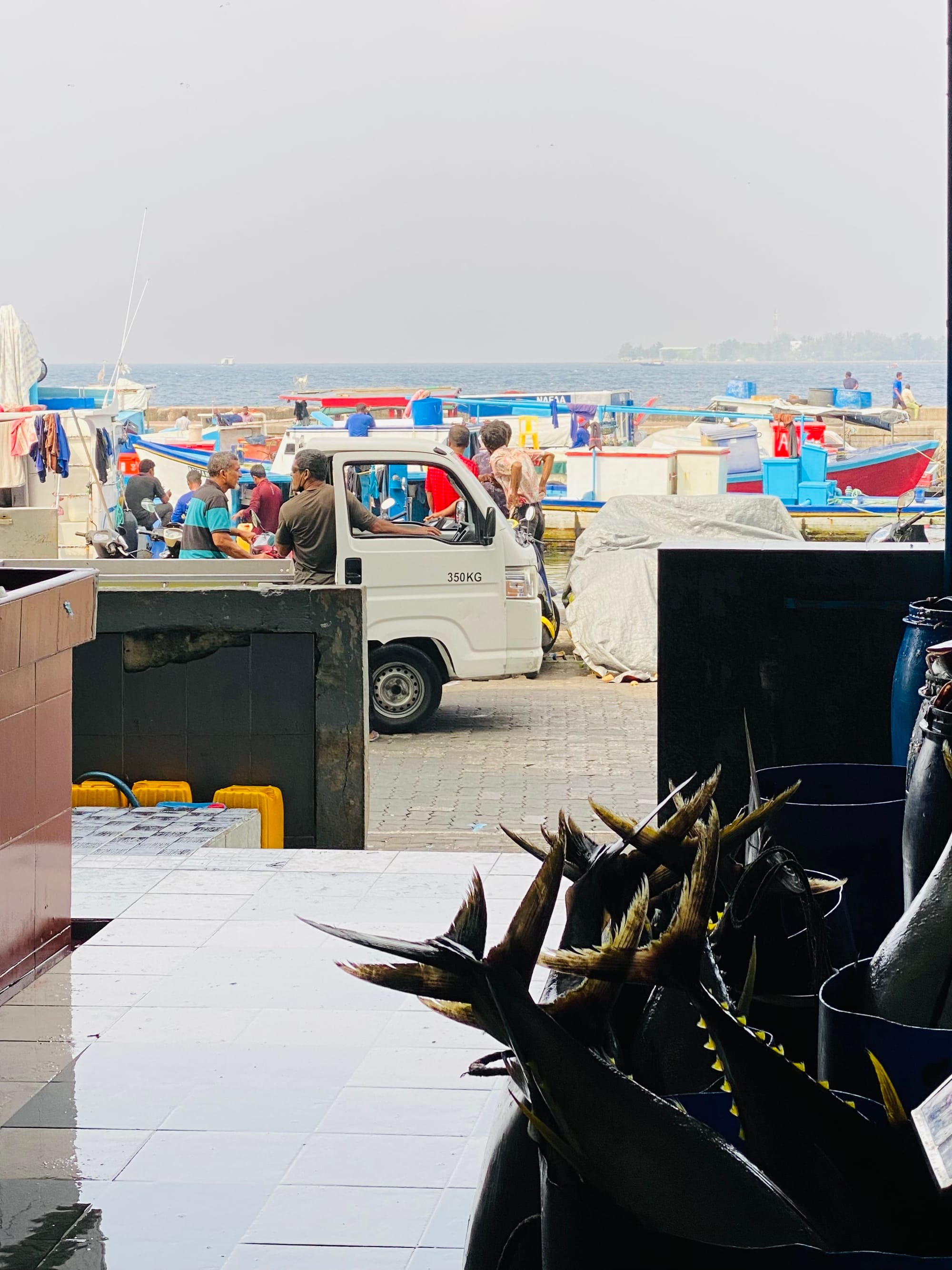
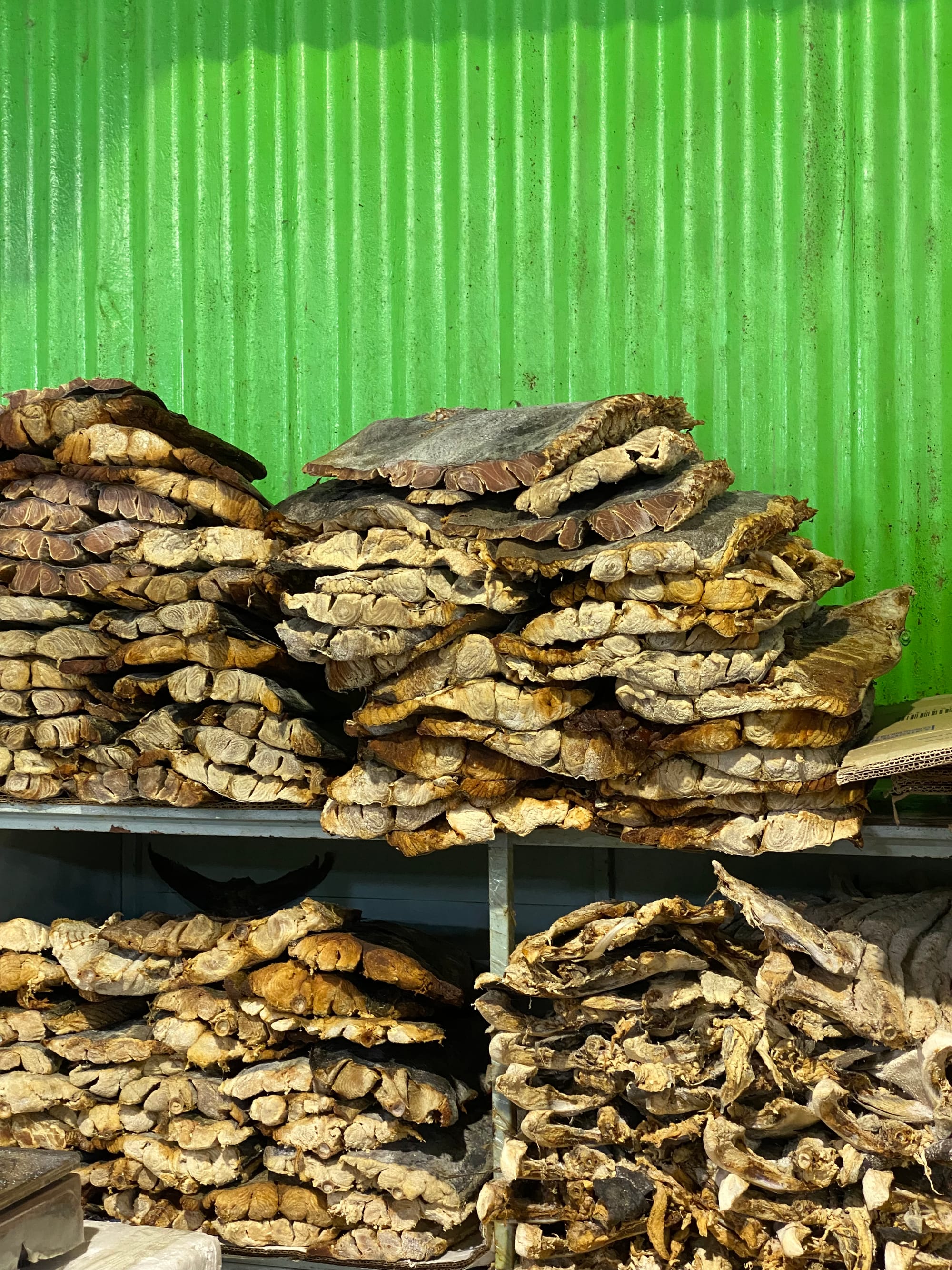
The fish market sits on the northern waterfront, where local fishermen arrive daily aboard traditional dhoni boats with their catch. Come at dawn if you can. The tuna are enormous, laid out on tiled floors while vendors work with speed and precision that speaks to generations of practice. It is loud, wet, and pungent in the very best way. Wear shoes you don’t mind getting fishy. Bring a camera but ask before you point it at anyone. Two minutes from the fish market is the fruit & veg market, which was my favourite place to visit in Malé. Worth visiting even if it’s the only thing you see of the capital. You will see tuna dried and preserved in just about every way imaginable, fruits you never knew existed, and various sizes of recycled plastic bottles with who knows what inside. Someone told me that the creative tuna processing is because it’s really the Maldives’ only natural resource. They’ve had plenty of time to get creative with tuna, and it shows! There’s no arable land and almost everything is imported. Keep in mind when you visit a resort in your luxurious over-water bungalow that everything, from shampoo, to bottled water, to fruit, to cleaning products…has traveled thousands of miles to get there.
If you have time to visit the Old Friday Mosque, it’s worth a trip. Built in 1658 from interlocking coral blocks — soft enough to cut when wet, rock solid when dry — it has stood for nearly 400 years and remains the oldest surviving mosque in the Maldives. The walls are etched with Quranic script, the interior decorated with fine lacquerwork and woodcarvings, and the adjacent cemetery has coral stone headstones whose designs marked the ranks and professions of those buried beneath them. It is quiet, unhurried, and completely at odds with the noise outside.
Diving in the Maldives
This is a subject of which there are significantly more opinions about due to the recent, tragic loss of 5 Italian divers. Diving in the Maldives requires experience, research and planning, and in-place safety measures. There are regularly 2–4 knot currents which can sweep you away from your boat and fellow divers, and even scarier are the down currents. Getting caught in a down current can easily bring a diver much deeper than they’d planned, or hoped to dive. This poses problems if you’re running low on air, are diving on nitrox and have depth limitations due to oxygen toxicity, are prone to getting nitrogen narcosis at shallower depths, or if you’re not paying attention to your dive computer and don’t realize that you’re essentially on the EAC (from Finding Nemo) and are caught in an underwater vortex that’s dragging you deeper and deeper. The channels between atolls can be wide, and although visibility can be excellent, we often found ourselves in a channel without seeing reef on either side of us. Combine this with our goal to dive a thila (a reef formation that rises from the ocean floor but doesn’t reach the surface… often found in the channels) there’s a good chance you can be swept off a thila and have no visible reef reference for depth. This is dangerous as you may not realize that you’re being pulled deeper and deeper. Justin and I got swept off a thila and into a powerful down current. Thankfully, I was watching my dive computer closely and both Justin and I managed to fin hard enough against the current and for long enough that it eventually released us and we were able to surface normally after our usual deco and safety stop. I will note that we are lucky enough to live and work on a boat owned by people who love to dive and we were diving very often at that point. We were diving every day, two or three times a day, with the same group of people. We knew each other’s capabilities, trusted our gear, were all in great physical shape and knew what limits we were comfortable pushing. I wouldn’t recommend diving in the Maldives to anyone who hasn’t been recently diving, isn’t in good physical shape, or doesn’t have a trusted dive buddy.
I log every single one of my dives and it’s become something of a diary for me. I use divelogs.org and love it! Going back through all my logs from the Maldives, I have a few tips if you’re diving there in January–March. Water temp was 81°F from a depth of 155ft to about 40ft… then could get up to 91 at the surface. When I’m diving multiple times a day in warmer waters, I usually wear a thin 2/3 surf wetsuit as they’re easy to get on and off and they’re often cheaper than a scuba wetsuit. (I recommend them unless they make you look like a tuna… but that’s a story for another time). My 3mm and 5mm suits are where I will happily spend money to be warm and comfortable. I have two 3mm Bare Evokes that I rotate on cold days and a 5mm iDry that I love. My 2/3 surf suit was fine for all but one or two dives here. If I had to pack a bag to go back, I’d bring a 2/3 surf suit and a vest as an added thermal layer if needed. Keep in mind, you’re always colder on your second dive! Another note… I wear free diving fins rather than scuba fins and they were so helpful against the current. You have to be super mindful of not hitting the reef, but if you’re thoughtful about where you put your feet/fins, with practice you’ll be fine.
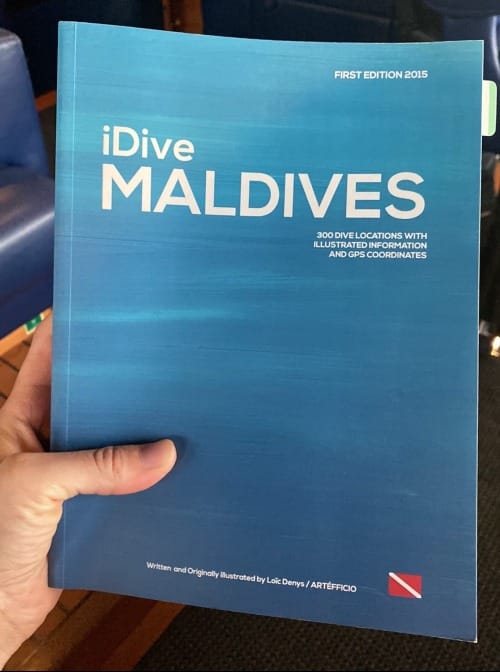
If you are planning to dive in the Maldives, I highly recommend getting a book that’s published locally called iDive Maldives! It was the single most useful resource we found. Our copy is well loved and has notes in the margins from all our dives. A great resource and a great memory.
How to dress
The Maldives is a Muslim nation and Malé is its capital — not a resort island with different rules. Shoulders and knees need to be covered for both men and women. You will be welcomed warmly for making the effort. Please don’t be that tourist ignoring the cultural norms because you’re “too hot” or “that’s not how I dress.” The point of traveling is to see other cultures. If you’re offending the locals when you travel, then what’s the point?
Worth knowing
Malé is the capital of a country made up of 1,200 islands, most of them barely above sea level, whose people have watched the ocean rise their entire lives. The fish market, the painted streets — all of it exists in a place the resort brochures don’t show you. It is worth seeing with your own eyes. If you visit the Maldives, but never leave the resort, can you say you’ve really been to the Maldives?