Iceland · Dateline: Saturday 11 July 2026
On the night of 21 June, two harpoon vessels that had left Reykjavík days earlier vanished — not beneath the waves, but from the screens. Hvalur 8 and Hvalur 9 switched off their Automatic Identification System, the transponder that lets any mariner or coastguard read a ship's position on a public map. To anyone watching from shore, the boats simply blinked out.
There is nothing illegal in it. The Icelandic Coast Guard confirmed the decision rests with each vessel's captain, and the ships still reported their positions privately, by satellite, every hour. But every seafarer knows what going dark signifies. You switch off AIS when you would rather not be watched. And Iceland's whalers had reason: the season's first two fin whales — the second-largest animal ever to live — were hauled up the slipway at Hvalfjörður at four in the morning, under police guard. They were the first killed in the country in three years.
The obvious question is why. Not why kill whales; that argument is old and well-worn. The stranger question, the one that repays a harder look, is economic. There is no meaningful market for the meat. Icelanders do not eat it. So who profits? Follow the money, and it does not lead where instinct expects — not to a dinner plate, a perfume house, or a pharmacy. It leads to a fishing-gear multinational, a Tokyo firm that cannot sell what it already holds, and a line in a government budget.
A bonfire, not a business
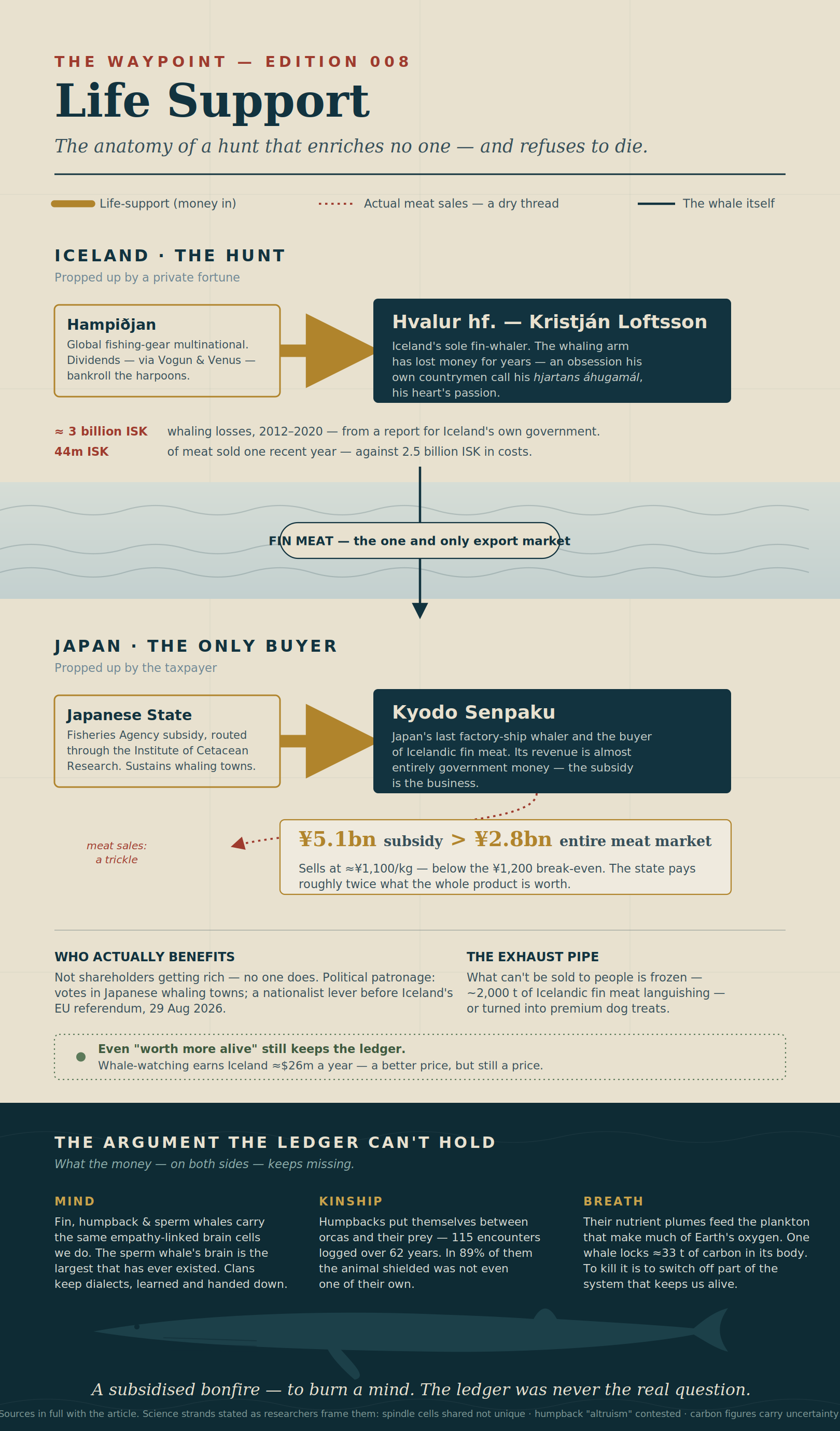
Begin with the company. Hvalur hf. is not really a whaling firm that struggles to sell meat; it is one of Iceland's larger investment houses that happens to own harpoons. Its whaling arm loses money, and has for years — around 3 billion krónur between 2012 and 2020, according to a report prepared for Iceland's own government. In one recent accounting year the company's ships, its cutting station and its export operation cost some 2.5 billion krónur to run, and sold 44 million krónur of meat.
Read those two numbers together, and it is not a business. It is a bonfire.
So where does Hvalur's profit come from? Elsewhere entirely. Through its subsidiaries Vogun and Fiskveiðihlutafélagið Venus, the company controls a commanding stake in Hampiðjan — a genuinely successful global maker of fishing nets and ropes, listed on Nasdaq Iceland, with operations from India to Chile. Hampiðjan's dividends are the money. The whaling is what a portion of that money is spent on. Its owner, Kristján Loftsson, now in his eighties, has hunted whales since he was a boy of thirteen scouting from his father's ship. Icelandic journalists call fin whaling his hjartans áhugamál — his heart's passion. A campaigner at IFAW called it perverse that he keeps killing fin whales he cannot sell.
Nearly every fin whale Iceland kills is bound for one country. Japan is the only buyer. And that market is not a market in any ordinary sense.
The subsidy is the business
Japan resumed hunting its own fin whales in 2024 and now sits on a glut. Before that season even opened it held more than 4,000 tonnes of whale meat in cold storage — including roughly 2,000 tonnes of unsold Icelandic fin meat from a single 2023 shipment. The buyer at the far end of Iceland's supply line is Kyodo Senpaku, Japan's last factory-ship whaler, and its finances are the crux of the whole affair.
Kyodo Senpaku's revenue is almost entirely government money. In one representative year the Japanese Fisheries Agency put ¥5.1 billion of subsidy into the industry, while the total wholesale value of all whale meat sold in the country was ¥2.8 billion. The state pays roughly twice what the entire product is worth. The meat sells at about ¥1,100 a kilogram — beneath the ¥1,200 at which the trade would break even. Every kilo loses money; the gap is filled from the treasury.
This is the answer to the question the hunt keeps posing. The money is real, and someone is indeed being kept afloat — but not by selling whale. The subsidy is the business. It endures because it buys something other than meat: jobs and votes in Japanese whaling towns whose politics have long been bound to the governing party. For decades Japan ran this same hunt under the banner of scientific research, selling the meat as a by-product, until the International Court of Justice ruled in 2014 that the programme was not scientific at all. The label is gone now. The subsidy remains.
A hunt as a lever
Iceland's timing carries its own charge. On 29 August the country votes on whether to reopen European Union membership talks — and the EU is firmly anti-whaling. Conservationists and pro-membership campaigners suspect the hunt is being used as a nationalist lever, a way to inflame the sovereignty question and stall a promised bill to end whaling this autumn. Whether or not that reading is right, the effect is the same: a loss-making hunt has become a political instrument.
None of it is quick for the animal. Iceland's own Food and Veterinary Authority found that, in a documented sample, 41 percent of harpooned whales endured prolonged deaths — an average of eleven and a half minutes, and in some cases as long as two hours.
There is a competing arithmetic. Whale-watching brings Iceland an estimated $26 million a year — a living, growing industry that a dead one directly threatens. Live whales, by nearly every measure the figures allow, are worth more than dead ones.
But notice what that sentence quietly concedes. It still puts the whale on the balance sheet. It answers the harpoon with a ledger of its own, and agrees to argue about the animal in the only currency the whalers accept. The deeper problem with the hunt is not that the numbers fail to add up. It is that we are keeping the books at all.
The argument the ledger can't hold
Consider what is actually being killed. A fin whale is not a stock to be managed; it is among the largest and longest-lived minds the planet has produced. Fin, humpback and sperm whales all carry spindle cells — von Economo neurons — the same specialised brain cells that, in humans, are tied to empathy and to rapid judgement in complex social situations. For years these were thought to belong to us and the great apes alone; the honest scientific position now is that we share them with whales, elephants and others, not that they are unique to any of us. The frontier moved, in other words, toward company, not apart from it. A sperm whale's brain is the largest that has ever existed, six times the mass of a human's. These animals live in matrilineal clans with distinct dialects — cultures, in the plain meaning of the word — that are learned, not inherited, and passed down the generations.
And there is a body of evidence, gathered patiently over decades, that ought to unsettle anyone who still thinks of a whale as a resource. The marine ecologist Robert Pitman and colleagues catalogued more than a hundred recorded encounters, spanning sixty-two years, in which humpback whales interposed themselves between attacking orcas and the orcas' prey — grey-whale calves, sea lions, and in one case Pitman watched himself, a Weddell seal, lifted clear of the water on a humpback's upturned chest and nudged back with a flipper when it began to slip. In the great majority of these episodes the animal being shielded was not even a humpback. Scientists are careful, and rightly so: some read it as misfired anti-predator instinct rather than deliberate rescue, and have coined the guarded phrase "inadvertent altruism." But hold the debate itself up to the light. Here is a creature whose behaviour is intricate enough that "is it being kind?" is a serious question researchers must argue over. You do not convene that argument about a herring.
You do not ask whether a herring is being kind. That the question is even open for a whale is the whole point.
There is, finally, a way in which the moral case and the survival case turn out to be one and the same — and this part needs no appeal to feeling at all. Whales are working infrastructure of the living ocean. Feeding in the depths and releasing vast nutrient plumes at the surface, they fertilise the phytoplankton that generate a large share of the oxygen every human breathes and that draw carbon out of the air on the scale of forests. A single great whale stores on the order of 33 tonnes of carbon in its body, carried to the seafloor for centuries when it dies. In 2019 economists at the IMF, reaching for a language power might listen to, valued one great whale at more than $2 million and the world's stock at around $1 trillion — while noting, as good scientists do, that the phytoplankton figures still carry real uncertainty. The number is not the point. The point is that to kill a whale is to switch off a part of the system that keeps the ocean, and therefore us, alive. The right of the animal to exist and our own interest in its existing are, it turns out, the same right.
Which returns us to the ships that went dark off Reykjavík. The instinct, watching a wealthy man refit harpoon boats to hunt an animal nobody will buy, is that there must be a hidden buyer — some black market, some lucrative by-product not yet named. We looked. There is not one. The truth is stranger, and harder to answer: this is a hunt that enriches no one, held up by two artificial supports — a private fortune at one end, a captured public budget at the other — to destroy one of the most intelligent, ecologically load-bearing forms of life on Earth, and then to argue about the loss in krónur and yen.
That is the real absurdity, larger than the accounting. The subsidised bonfire is only the surface of it. Beneath it is a question no ledger on either side of the debate — whaler's or tourism board's — is built to hold: whether a species that sings across ocean basins, protects the helpless of other species, and quietly runs one of the planet's carbon engines has a claim to go on existing that is simply not ours to price. The ships switched off their transponders because they did not wish to be watched. The more revealing thing is what comes into view when you stop counting, and look.
— Justin Jenkin
Sources
The kills & the blackout: IFAW, First fin whales killed as Iceland's whaling resumes; Iceland Review, Whaling Ships Go Dark as Hunting Season Begins; Oceanographic, Two fin whales dead as Iceland's hunt returns.
Hvalur's finances & corporate structure: Iceland Review (Heimildin figures), Whaling: a loss-making business; Oceanographic, Iceland stands on the brink; Hampiðjan investor filings (Vogun / Venus holdings); EIA, Iceland flouts international ban.
Japan's subsidy & Kyodo Senpaku: Asia News Network / Yomiuri, Whaling industry struggling after three years; OceanCare, Crowdfunding for whaling in Japan; The Diplomat, The Resilience of Japanese Whaling; AWI, Japanese Whaling.
The "scientific" label & the ICJ ruling: Institute of Cetacean Research overview (2014 ICJ ruling); National Geographic, Illegal international trade in whale meat.
Politics & the referendum: 2026 Icelandic EU referendum; Telegraph via Yahoo, Iceland's EU referendum could finally kill off whaling.
Welfare: Humane World for Animals, Iceland and whaling.
Intelligence & culture: Hof & Van der Gucht, Cetaceans Have Complex Brains for Complex Cognition (PLOS Biology); Smithsonian, Brain Cells for Socializing; Toward understanding communication in sperm whales (iScience); Wider-distribution caveat: Cetacean intelligence.
Interspecies protection (the "altruism" study): Pitman et al., Marine Mammal Science (2016), summarised in Science; National Geographic, Why Humpback Whales Protect Other Animals; Cautious reading: Discover, "inadvertent altruism".
Whales as carbon infrastructure: IMF Finance & Development, Chami et al., Nature's Solution to Climate Change; National Geographic, How much is a whale worth?; Uncertainty caveat: Sustainability by Numbers.
Further Reading
The pro-whaling / sustainable-use case: Government of Japan, Ministry of Foreign Affairs, Whaling in Japan; Government of Iceland, Policy on Whaling.
The sovereignty & fisheries case against EU membership: Konrad-Adenauer-Stiftung, Iceland's EU Referendum: The Road to August 29.
The conservation case: Whale and Dolphin Conservation, Whaling in Iceland; Captain Paul Watson Foundation.
Editor's note on sourcing
Two financial figures rest on single strong sources and are flagged accordingly: the Icelandic government-commissioned loss estimate (≈3bn ISK, 2012–2020), and the account of Japanese whaling-town political patronage. The pre-2019 "scientific whaling" characterisation is grounded in the 2014 International Court of Justice ruling. The Waypoint makes no claim of fraud: Japan's subsidy is openly appropriated and openly spent — the story is one of public money sustaining a commercially dead industry, not of deception. On the science, we have kept to what the researchers themselves claim: spindle cells are shared across many species, not unique to whales; the humpback "altruism" is genuinely contested, with "inadvertent altruism" the authors' own hedge; and the whale-carbon valuations carry real uncertainty in the phytoplankton estimates, which we cite as an argument's order of magnitude, not a settled figure. The moral conclusion is left to the reader; the piece supplies the evidence, not the verdict.